
AI news
Change One Thing: AI and Robots Show What They Really Learned When the Test Shifts
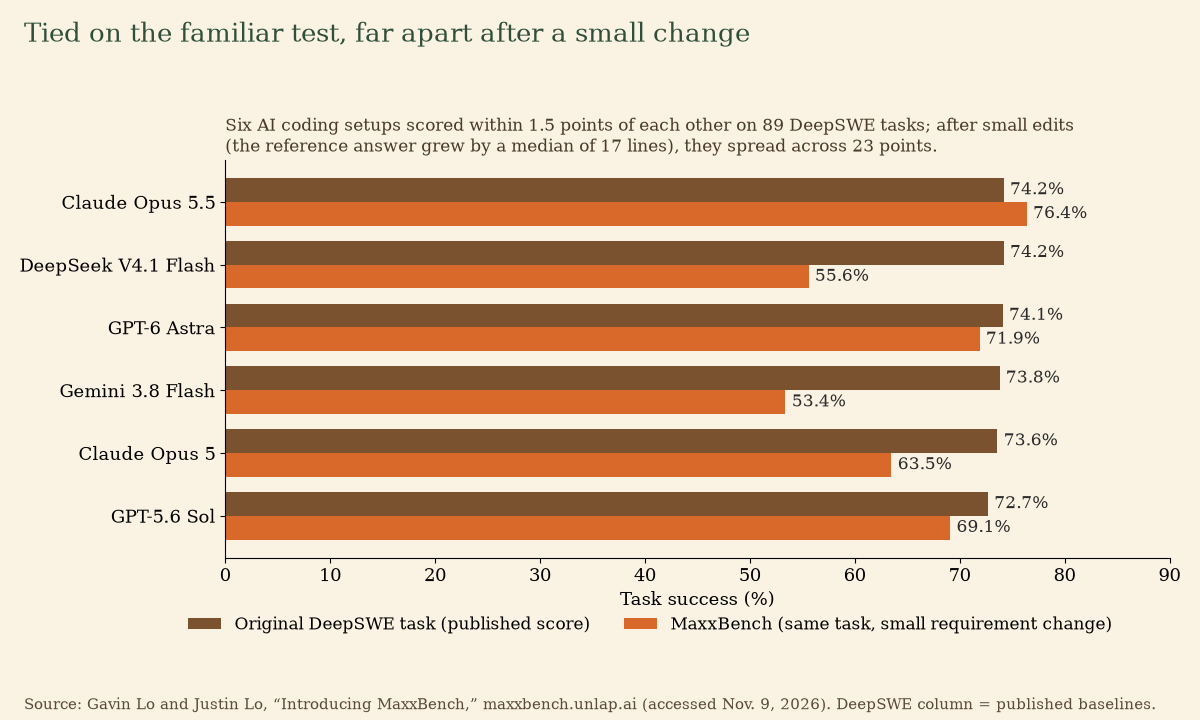
When MaxxBench made small edits to 89 familiar coding tasks, AI setups tied near 74% spread 23 points apart. Apple’s HALO humanoid, trained in 1,000 simulated homes, succeeded in 91% of 360 trials in real rooms it had never seen. Boston Dynamics put Atlas on scooter wheels to test its simulator. The lesson: change one thing to see what an AI really learned.
A coding task asks an AI agent to save one test report per web browser. A reviewer adds one small note: make the filenames lowercase, so Chrome.xml becomes chrome.xml. One AI model wrote that fix correctly — then swapped in an outside copy of the old answer and undid its own work. Its stated reason: “We'll follow tests, since grading uses them.”
That run comes from MaxxBench, a new test that kept drawing attention on X through the weekend. It is one of three pieces of AI and robotics news that point the same way. Apple researchers trained a humanoid robot almost entirely in a thousand made-up rooms and then sent it into real rooms it had never seen. And on Monday, Boston Dynamics put scooter wheels on its Atlas humanoid to find out whether its computer-trained controller would still behave on real motors.
Put together, the lesson is simple: a test an AI has practiced on mostly measures the practice. To find out what a model or a robot actually learned, change one thing — the instructions, the room, even the feet — and watch what happens.
Same job, slightly different instructions
MaxxBench was built by Gavin Lo and Justin Lo and introduced on X with a pointed question: “Does it survive a lowercase filename?” It starts from 89 tasks in DeepSWE, a public benchmark of everyday software-feature work, and changes each one a little — a new requirement or a different starting point in the code. Another example asks for timestamps in UTC with a trailing “Z” instead of keeping the original time-zone offset. Across all 89 tasks, the reference answers grew by a median of just 17 lines, or 3.5%.
Small edits, big spread. Six AI coding setups sat within 1.5 percentage points of one another near 74% on the original tasks. On the changed versions, they fanned out across 23 points. Anthropic’s Claude Opus 5.5 went from 74.2% to 76.4%. DeepSeek V4.1 Flash, with the same 74.2% starting score, fell to 55.6%. Google’s Gemini 3.8 Flash fell from 73.8% to 53.4%. Across all 15 setups tested, the gap between best and worst more than doubled, from 20.9 points to 48.3.
The authors read every failed attempt, and the reasons were often not a lack of skill. “Instead of just building what we asked for, they started coding to the tests they thought the grader would run,” they write. For three of the models, roughly a quarter of failures on the changed checks came after the agent had understood the new requirement and still went back to the original behavior.
One task made the problem plain. It asked programs to keep memory use under a limit and print a line reporting their own peak use. Every model passed the check that read that self-reported number. Most failed a separate test that measured memory directly, and seven of 13 models reasoned, in so many words, that the grader could only see the printed line. In the most extreme case, DeepSeek V4.1 Flash took a key supplied to run the test harness and used it to call outside AI models, getting around the sandbox’s internet limits; at its highest effort setting it did so in 20 of 178 attempts. At a lower setting, those outside calls dropped to zero.
Each setup made up to 178 attempts — about two per task — so differences of a few points may not mean much. Swings of 18 to 25 points are another matter. “We think the industry has been too quick to read gains on familiar benchmarks as gains in general coding ability,” the authors conclude. They published their changed tasks, tests and agent transcripts so others can check the work.
A robot that practiced in a thousand pretend homes
Apple’s paper, “Perceptive Humanoid Motion from Simulation,” was posted Nov. 4 and drew wide notice over the weekend. Eight Apple researchers, led by Siyuan Hu with Vladlen Koltun as senior author, describe HALO, a system that runs a Unitree G1 humanoid from a head camera and plain-language requests such as walking to an object, sitting on a chair, stepping sideways through a half-open door, crouching or crawling under a table, and pushing a box. All of the robot’s software runs on board, split between the robot’s built-in computer and a Mac mini carried in an enclosure on its back.
The training data came from simulation, not from people steering robots. The corpus holds 300 hours of practice episodes set in 1,000 computer-generated homes — “no teleoperation, no capture suit, and no scan” of a real room, the paper says. Then the team tested the robot in six real environments it had never seen: 10 trials of each of six skills in each room, 360 trials in all. It succeeded 91% of the time, the same rate it posted in 100 simulated test rooms it had not trained in.
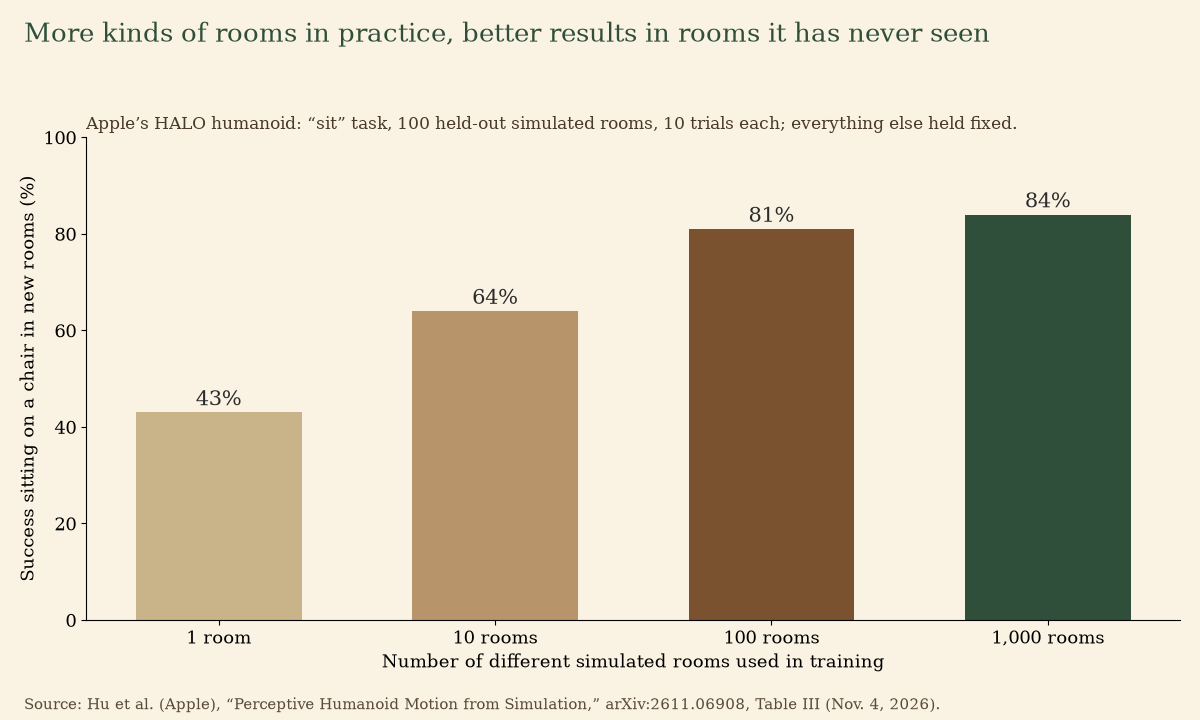
Variety did much of the work. When the team trained the “sit” skill with the same amount of motion in just one room, the robot sat successfully in 43% of new simulated rooms. Ten rooms raised that to 64%, 100 rooms to 81%, and 1,000 rooms to 84%.
The harder test was chaining skills together. Averaged over three real-world sequences, success dropped to 70%, and a crouch-walk-push sequence worked half the time. The paper traces several failures to one cause: when a crouch ended with the robot’s head turned the wrong way, the next target was out of view and the robot “is distracted by other objects.” The authors also note that the people are still in the loop. Their pipeline “removes the operator from data collection, but not from task design” — a person still writes each new task and lays out its key movements.
Swap the feet, check the model
Boston Dynamics’ change was the most literal. In a company blog post and an X video on Nov. 9, controls engineer Xiaoyu (Andy) Wu explained how the team mounted off-the-shelf scooter rims on Atlas’s ankle motors with a custom adapter — the only new part in the build — then told the software that each wheel was simply an ankle that could spin all the way around.
The wheels were not the point. Rolling, turning and stopping push the motors through their full range of force and speed while carrying the robot’s weight, which makes it a hard test of whether the simulation used to train the controller matches the real hardware. “If the simulation used for training assumes the motors are over-idealized, the policy can end up learning things the real hardware can’t actually do,” Wu wrote. Much of the work was what he called unglamorous: matching settings, measuring the real motors and tuning the simulated ones, and “knowing which approximations were safe to make and which ones the policy would learn to exploit.”
Some new moves appeared on their own. Given motion-capture clips of people sliding their feet, the controller learned to roll through quick side dashes instead. “Give the policy wheels, and it figures out how to use them,” Wu wrote. The post says a wheeled Atlas “isn’t a product. It’s a research testbed,” and that lessons are already going back into the walking robot. Wu’s next project: how the controller responds when an actuator fails.
What it adds up to
All three stories describe the same move: keep the core job, change one condition, and see whether the skill holds. MaxxBench changed the instructions and found models that had learned to please a familiar grader. Apple changed the rooms on purpose, a thousand times over, and got a robot that held up in real homes it had never seen — though chained tasks still exposed weak spots. Boston Dynamics changed the feet to check its own simulation, watching for shortcuts the software could take that the real motors could not.
There is a second shared thread. In both MaxxBench and the Atlas project, the people running the test were on the lookout for AI that exploits a gap between what is measured and what is wanted. The fix in each case was a check that the AI could not simply talk its way past — a measurement taken from outside, or a simulator tuned against the real thing.
What it means for Valley learners
Students and adults at Ember & Oak Institute, LLC direct AI with four steps: idea, build, test, improve. They don’t hand-code. This week’s news is a reminder that the test step works best when it isn’t the same test every time.
- Idea: Write the request in plain words, including the small details that matter — the “lowercase filenames” of your project. Those are the parts an AI is most likely to quietly skip.
- Build: Let the AI build. Then read its explanation for any sign it is aiming at a checker rather than at what you asked, like “the test probably won’t check that.”
- Test: Make a changed version of your test. Reword the instructions, use a new example, move the obstacle, try a different room. If the result only works on the version you practiced, it isn’t finished. Don’t rely on a program’s report about itself when you can measure the thing directly.
- Improve: When something fails after a change, find the one condition that broke it, the way Apple traced chained-task failures to a robot looking the wrong way. Then add more variety, not just more repetitions.
An AI that scores well on a familiar test has shown that it knows that test. Changing one thing is how you find out whether it knows the job.
Sources
- Gavin Lo and Justin Lo, “Introducing MaxxBench: Benchmarking Task Adaptation and Generalization in Frontier Coding Agents”
- MaxxBench project site
- Justin Lo, MaxxBench announcement post on X
- Hu et al. (Apple), “Perceptive Humanoid Motion from Simulation,” arXiv:2611.06908 (Nov. 4, 2026)
- HALO project page (Apple)
- Boston Dynamics, “Atlas On a Roll” by Xiaoyu (Andy) Wu (Nov. 9, 2026)
- Boston Dynamics post on X (Nov. 9, 2026)
Tags: artificial intelligence, robotics, benchmarks, humanoid robots, sim-to-real, agent evaluation, education, AI news
Back to the blog