
AI news
From Imagined Worlds to Real Work: This Week's AI and Robot News Is About Closing the Gap
An AI lab let a simulated fruit fly brain loose in a computer-imagined world, Google got a quantum idea from 2024 working on its real chip, and a Beijing company pitched a 13-foot robot for dangerous jobs. Together they show where the hard work in AI and robotics now sits: between the practice world and the real one.
A fruit fly is cruising over a harbor that does not exist. The water, the boats and the buildings are being invented, moment by moment, by an AI model. The fly's brain is software, too.
Odyssey, an AI lab, posted the 30-second clip on Saturday. It said it had placed "the fruit fly brain" inside its Odyssey-3 world model, and that the fly is now "flying around totally imagined, simulated worlds all by itself" (Odyssey on X). By Sunday morning the post had passed 3 million views.
It is a striking picture of where AI and robotics are heading: machines, and now even simulated brains, getting practice in worlds a computer dreams up. But the week's other big stories are a reminder that the imagined world is only the warm-up. Google needed months of detective work before a quantum computing idea that "looked great" on paper worked on its real chip, and a Beijing robot maker is pitching a 13-foot machine for jobs where there is little room for a do-over. For Mat-Su Valley homeschool families, the lesson sits in the gap between the two, and in learning how to close it.
A brain, a map and a made-up world
Odyssey released Odyssey-3 on Oct. 8. The company says the model "predicts how objects move and interact through space and how situations evolve over time," after learning from internet video, recorded gameplay and simulated objects bumping into each other (Odyssey). Odyssey says world models like it will "generate environments in which other intelligences can train" (Odyssey).
The fly half of the demo rests on years of human work. In 2024, the FlyWire Consortium published a complete wiring map of an adult female fruit fly's brain in the journal Nature: 139,255 neurons and 54.5 million connections between them (Nature). The researchers estimated the map took about 33 person-years of hand-checking, with help from citizen scientists recruited from Eyewire, an online brain-mapping game (Nature).
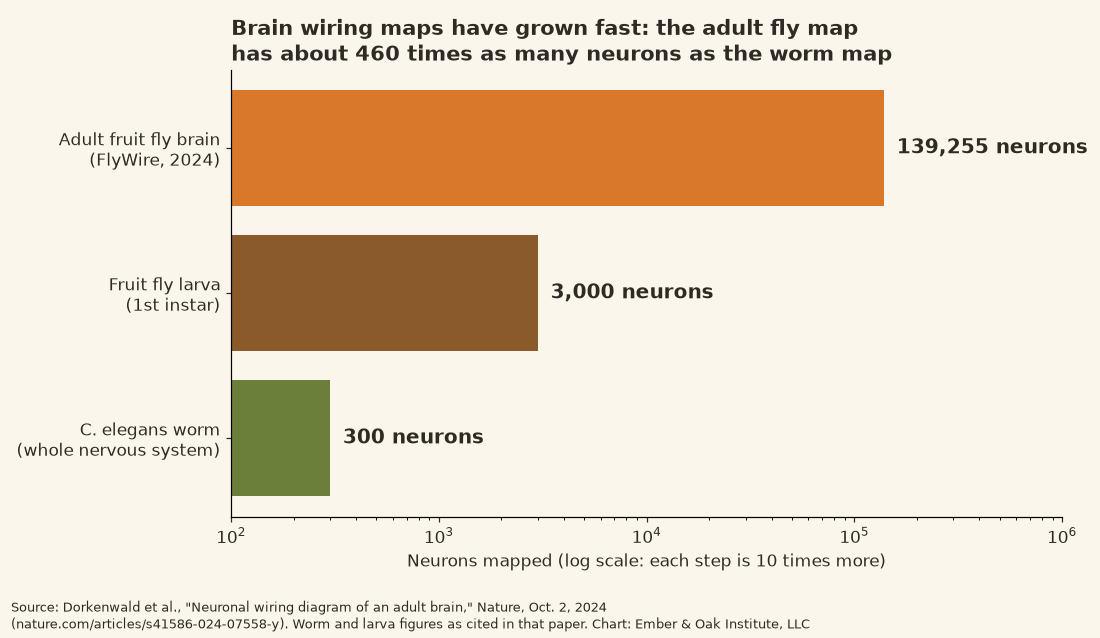
The adult fly brain map has about 460 times as many neurons as the worm map. Source: [Dorkenwald et al., "Neuronal wiring diagram of an adult brain," Nature](https://www.nature.com/articles/s41586-024-07558-y), Oct. 2, 2024. Chart: Ember & Oak Institute, LLC.
Odyssey's post did not say which fly-brain model it used, how the made-up scenery was turned into signals for the fly's eyes, or how the fly's commands steered it through the world (Odyssey on X). Until the company explains, viewers can't tell how much of the flight comes from the brain and how much comes from the world model drawing whatever comes next. That is the question worth watching.
"On paper, it looked great"
Google Quantum AI's result, published in Science on Oct. 15, is a story about exactly that kind of gap (Science). Quantum computers need special ingredients called "magic states" to run useful programs. Making good ones is so costly that some estimates said up to 95% of a quantum computer's capacity might go to producing them, Google wrote.
In 2024, Google researchers Craig Gidney, Noah Shutty and Cody Jones worked out a method they call "magic state cultivation." It acts like a filter: start with a rough state, run a series of checks and throw out every flawed attempt. "On paper, it looked great," the team wrote (Google).
Real hardware was another matter. While testing the method, research scientist Emma Rosenfeld kept seeing data that "seemed to defy the laws of physics." After months of simulations, discussions and checks, she traced the problem to electrical equipment drift and temperature changes in the lab that were quietly throwing off the team's go-to measuring method. The fix took extra controls and a brand-new way of measuring (Google).
The payoff: on Google's Willow processor, the kept states had about 40 times fewer errors than states made without cultivation and reached a record 99.99% fidelity (Google; Google Quantum AI on X). The filter is strict. Only about 8% of attempts made the cut (Rosenfeld, Gidney et al.). Google says it still needs to show the method works "at a larger scale" (Google).
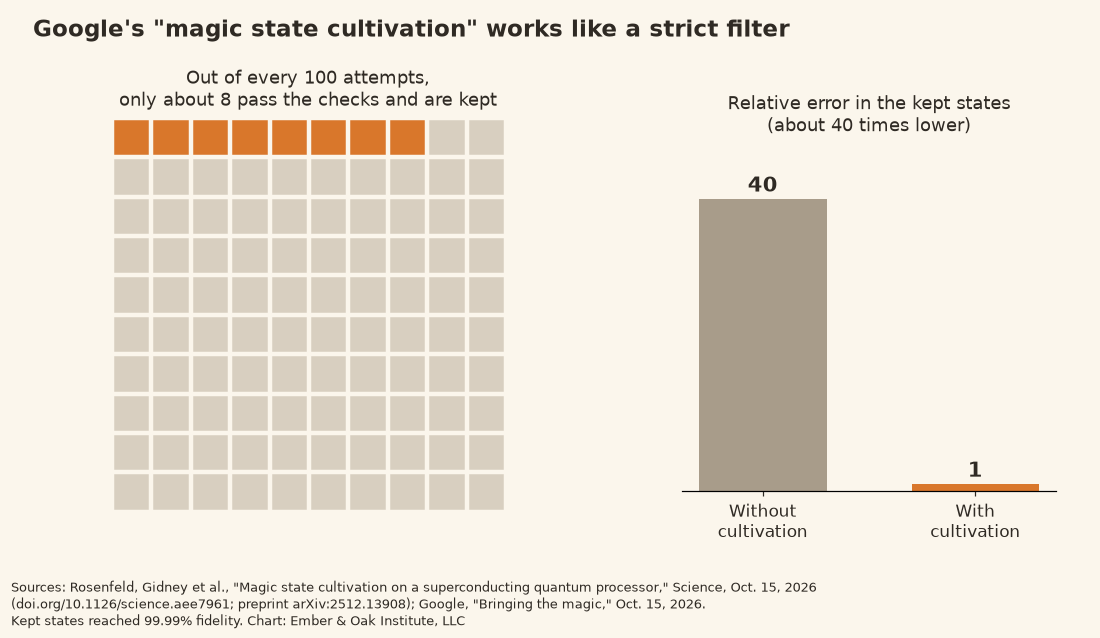
Cultivation keeps only about 8% of attempts, but the kept states have about 40 times fewer errors and reach 99.99% fidelity. Sources: [Rosenfeld, Gidney et al., Science](https://www.science.org/doi/10.1126/science.aee7961) (preprint arXiv:2512.13908) and Google, Oct. 15, 2026. Chart: Ember & Oak Institute, LLC.
A giant built for the "4D" jobs
The week's biggest robot, literally, comes from NeodraDynamics, a Beijing company founded by engineers with Tsinghua University backgrounds. In a release dated Oct. 14, it said it unveiled Neo1 with partner JD Industrial at the China International Industry Fair. Neo1 is a 4-meter-class (about 13-foot), 1.2-ton humanoid with 41 moving joints, 39 of them driven by the company's own small hydraulic actuators. The company claims the two arms together can lift 500 kilograms, or about 1,100 pounds (NeodraDynamics via PR Newswire).
NeodraDynamics aims Neo1 at what it calls "4D" work: dangerous, dirty, difficult and dull. Its list includes heavy assembly, port cargo, nuclear plant maintenance, deep-sea repairs, mining and disaster cleanup, jobs familiar to many Alaskans (PR Newswire; NeodraDynamics). "Robots should not merely replicate human forms but surpass human physical limits," founder Yang Tao said (PR Newswire).
For now, those are planned uses. The company says it and JD Industrial will work on pilot applications to prove the robot in real industrial settings (PR Newswire). In those places, a mistake costs far more than a restart button.
What it adds up to
Taken together, the week's news says the flashy part of AI, the demo, keeps getting easier to make. The hard part is still the trip from the imagined world to the real one. A fly brain in a dream world needs a clear account of how it is wired in. A quantum trick needed months of chasing lab noise. A 13-foot robot still has to prove itself on a real job site.
That trip is the same loop Ember & Oak Institute, LLC learners follow when they direct AI to make something: idea, build, test, improve. A practice world, like a simulation or a quick prototype, is a fine place for the first test. The "improve" step starts when the real world disagrees, and as Rosenfeld's puzzle shows, that surprise is often the most interesting part.
Try it at home: Pick a project your learner has built with an AI helper, such as a simple game or a sorting program. Ask three questions: Where did we test it? What might be different in real life? How could we find out?
Sources
- We placed the fruit fly brain inside Odyssey-3, Odyssey on X (Oct. 17, 2026)
- Meet Odyssey-3: Our Most Powerful Foundation World Model, Odyssey (Oct. 8, 2026)
- Neuronal wiring diagram of an adult brain, Dorkenwald et al., Nature (Oct. 2, 2024)
- Bringing the magic: Google breaks open a bottleneck in quantum computing, Google (Oct. 15, 2026)
- Magic state cultivation on a superconducting quantum processor, Rosenfeld, Gidney et al., Science (Oct. 15, 2026)
- Magic state cultivation on a superconducting quantum processor, arXiv:2512.13908 (preprint)
- Google Quantum AI on X (Oct. 15, 2026)
- NeodraDynamics Showcases 4-Meter & 1.2-Ton Neo1 Heavy-Duty Hydraulic Robot with JD Industrial at CIIF, PR Newswire (Oct. 14, 2026)
- NeodraDynamics company site