
AI news
Off the Map: Robots Are Learning to Work Where the Roads, GPS and Operators Run Out
A university drone followed a runner through a forest with no GPS signal, and a company whose excavators dig with no one in the cab raised $600 million. Machines are heading off the map. People still set the plan, and someone still has to check the claims.
On Friday, a university drone chased a runner through a forest with no GPS signal and no map. On Monday, a company whose excavators dig with no one in the cab raised $600 million. Machines are heading off the paved, mapped world, and the people around them are still setting the plan and checking the work.
For most of their history, robots have worked where the world is tidy: factory floors, warehouses and marked city streets. The robotics stories drawing the most attention this weekend were about the opposite. A Purdue University lab posted video of a drone following a person through dense woods it had never mapped. Bedrock Robotics announced new funding to put self-driving excavators on more U.S. construction sites. And a programmer showed what it looks like when a person makes every design decision and AI writes every line of code. Together they point to one shift. Machines are taking on real work in messy, unmapped places, but humans still decide where they go, and someone still has to check whether the claims hold up.
Under the canopy
Aniket Bera, an associate professor of computer science at Purdue, posted a 44-second video on LinkedIn on Oct. 23 of a drone from his IDEAS Lab following a person through a forest, DroneXL reported. In his post, Bera described the setting as “an unmapped, GPS-denied forest” and said the drone does its computing onboard rather than relying on the cloud. Under thick tree cover, a drone can’t count on satellites to tell it where it is. It has to work that out from its own sensors, build a map as it flies and guess where the runner went when a tree blocks the view. Asked about that last problem, Bera replied that a prediction module estimates the person’s path when they disappear or tracking gets noisy, according to DroneXL.
The clip spread fast. Two reposts on X passed 1.7 million views combined by Monday, DroneXL reported, and some of them added claims the lab did not make. An English rewrite, past 1 million views on its own, promised “massive implications” for search and rescue, but Bera’s post says nothing about search and rescue. A Japanese-language repost was more careful, noting that this was a research demo whose real-world performance and safety still needed checking. Even the technical details shifted: Bera’s post lists camera-based “visual-inertial odometry,” but a Purdue graduate student wrote in the comments that the drone locates itself with LiDAR-inertial odometry, which uses a laser scanner, DroneXL reported.
The demo itself is modest. Reading the video frame by frame, DroneXL found that the drone topped out near 3 meters per second, about 7 mph, flying roughly 2 meters off the ground and 5 to 10 meters behind the person. As of Monday, the lab had not published a paper on the forest flights. Purdue announced in November 2025 that Bera’s lab had received a five-year, $1.5 million Army Research Laboratory agreement to develop air and ground robots that map and navigate without GPS. Bera’s post does not say what paid for the forest flights.
Built on a shared map
The video also shows how much modern robotics rests on shared tools. Labels in its on-screen flight data name the motion planner as SUPER and the altitude estimate as FAST-LIO, both free, open-source packages from Fu Zhang’s MaRS Lab at the University of Hong Kong, DroneXL reported. Bera’s post, which says the lab built “every layer” of the drone “from scratch,” does not mention the Hong Kong lab. DroneXL’s editor called building on those tools “the smart move” but argued the lab should credit the MaRS team.
SUPER has its own track record. In a 2025 paper in Science Robotics, the Hong Kong team described a compact LiDAR drone that flew faster than 20 meters per second, about 45 mph, through unfamiliar places while dodging thin obstacles, and said its planning method cut failure rates 35.9 times compared with earlier approaches, according to the university’s summary. The researchers wrote that drones like it could improve “search and rescue and disaster relief.” That is where the search-and-rescue framing actually comes from: a peer-reviewed paper on the open-source tools, not the Purdue post.
No one in the cab
Bedrock Robotics, a San Francisco company founded in 2024 and led by former Waymo self-driving-car engineers, said Monday that it had raised a $600 million Series C at a $4.1 billion valuation, co-led by CapitalG and Emergence Capital, bringing its total funding to nearly $1 billion, according to the company’s announcement. Bedrock bolts sensors and computers onto excavators that contractors already own, in a same-day installation with no permanent changes, the company said in August.
That August announcement marked the milestone behind the new money. Bedrock said its excavators had begun working fully autonomously on paying customers’ sites, including a water treatment plant in Nevada with Sundt Construction and a 1.2 million-cubic-yard sitework project with Zachry Construction Corporation. A site manager sets the plan, and if a person or unexpected object gets too close, the excavator stops on its own until the area is clear, the company said. In Monday’s release, Bedrock said its newest partner, Haydon, will use the system for fully autonomous earthwork on a remote site in Texas, and that new customers are taking it into Minnesota, Florida, Virginia, Colorado, Missouri, Georgia and Arkansas.
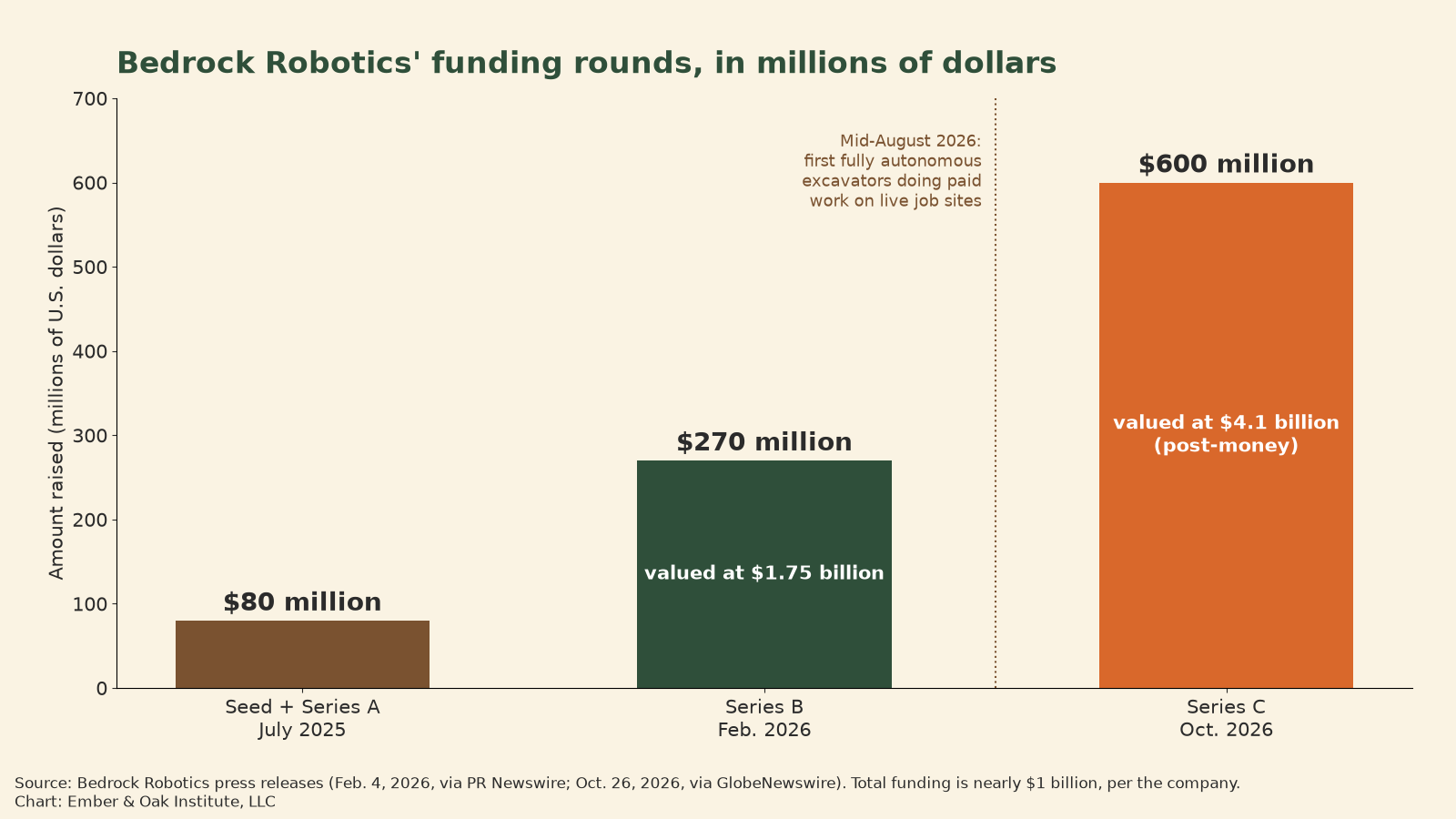
Source: Bedrock Robotics Series B release, Feb. 4, 2026 and Series C release, Oct. 26, 2026. Chart: Ember & Oak Institute, LLC.
Contractors say remote, repetitive digging is exactly the work that is hardest to staff. “The biggest challenge we face isn’t just finding operators,” Sundt project manager Dan Green said in a Bedrock post; it is keeping experienced ones engaged through “months of repetitive earthmoving in remote locations.” With the machine loading trucks, he said, skilled crews can focus on “more specialized and creative problems.”
The labor numbers back up the worry. In the 2026 workforce survey by the Associated General Contractors of America and NCCER, 87% of construction firms reported openings for hourly craft positions, and 88% of those firms said the jobs were as hard or harder to fill than a year earlier. Half said available candidates lack the skills, certificates or licenses they need, and 42% said worker shortages had delayed projects, the survey release.pdf) said. Bedrock’s performance and customer figures come from the company and its investors and have not been independently audited.
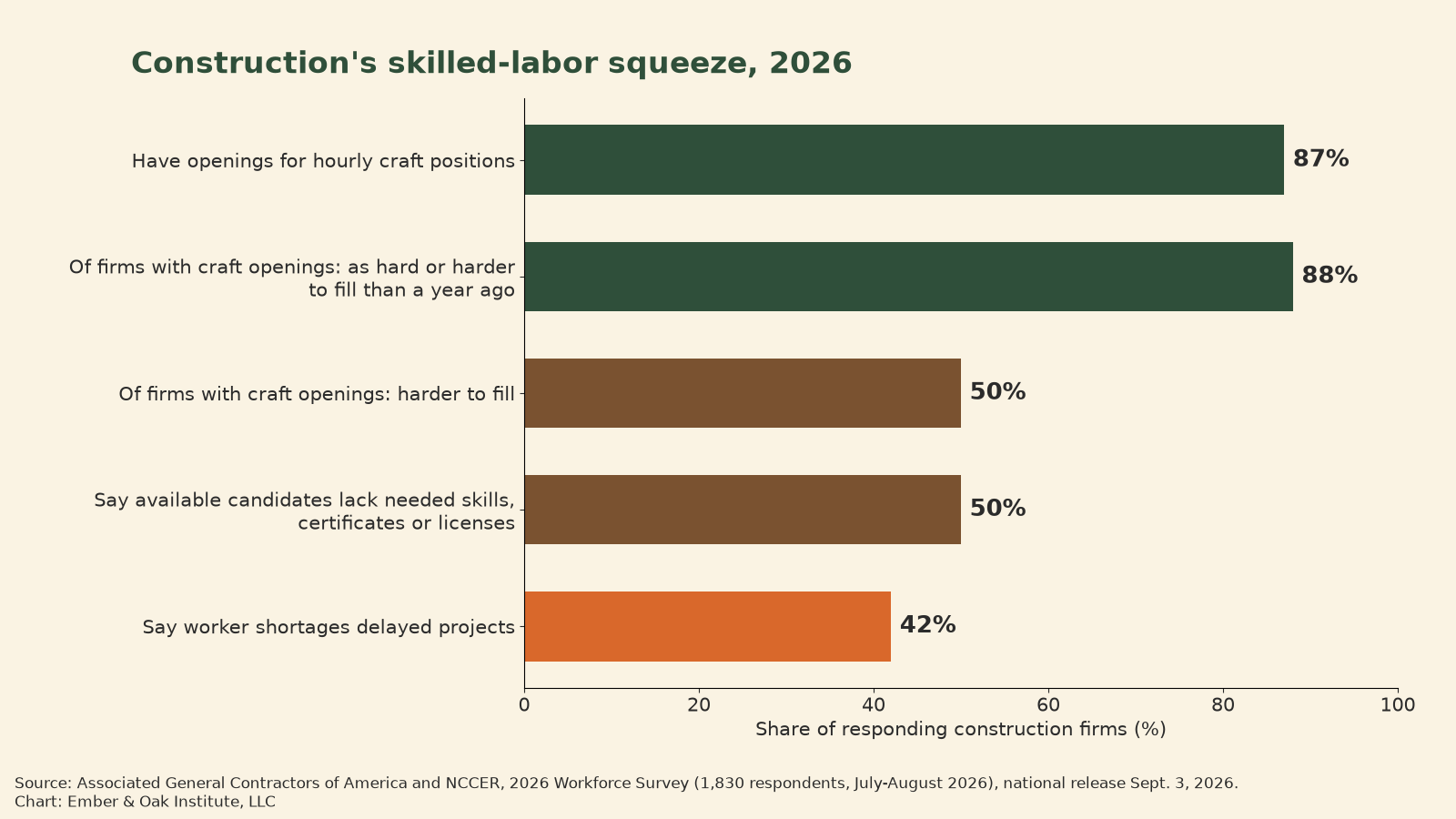
Source: Associated General Contractors of America and NCCER, 2026 Workforce Survey, national release, Sept. 3, 2026.pdf) (1,830 respondents). Chart: Ember & Oak Institute, LLC.
The human steers, the machine builds
The same split between planning and doing showed up in software. On Oct. 23, Xiangpeng Hao, a programmer who spent his PhD building B-trees, released bbtree, a B-tree, the kind of sorting structure that sits under databases and file systems. Hao reports that on his own benchmarks it runs about five times faster than the standard version built into the Rust programming language on a single thread. The striking part is how it was made. “All of the code is written by LLMs, but Xiangpeng steers every design decision, and is accountable for the code,” his write-up says.
Hao argues that speed is the easy part to hand off, because “speed is measurable, and LLMs can iterate on it relentlessly.” Being correct is harder, since “you can never write enough tests to prove the code correct.” So he stacks checks: random tests that compare every answer with Rust’s standard version, mathematical proofs of key properties, and tools that replay thousands of thread schedules. One of those tools caught a bug another had missed, which has since been fixed, according to the post.
What it adds up to
In all three stories, a machine takes the part of the job that is repetitive, risky or hard to staff: keeping a runner in view under the trees, loading trucks for months at a remote site, typing thousands of lines of code. In all three, a person still sets the goal: the researcher’s question, the site manager’s plan, the programmer’s design decisions. And in all three, checking is the job that doesn’t go away, from the excavator’s automatic stop zone to Hao’s proofs to readers tracing a viral clip back to the original post.
That matters in a place like the Mat-Su Valley, with big forests, plenty of country between roads and a building boom that needs skilled hands. A forest-tracking drone that can help find a lost hiker is still a research demo, not a product. Self-driving excavators are real, but they are working in the Lower 48 under close supervision. The jobs taking shape around them reward people who can plan the work, run and supervise machines and spot when something is off.
At Ember & Oak Institute, LLC, learners don’t hand-code. They direct AI tools through a simple loop: idea, build, test, improve. This week’s news is a grown-up version of that loop. The machines are getting better at the build step, even off the map. The idea and the test are still ours.
Try it at home: Pick one viral science or robot post and play source detective with your learner. Find the original, whether it’s a lab page, a paper or a company release, and list what the repost added, dropped or changed. Then have your learner direct an AI helper to build a simple “follow the leader” game in which one dot chases another through a field of trees with no map. Test what happens when the leader ducks behind a tree, and improve it by adding a “guess where it went” rule.
Sources
- DroneXL, “Purdue’s ‘From Scratch’ Drone Flies on a Hong Kong Lab’s Planner” (Oct. 26, 2026)
- Aniket Bera, LinkedIn post on the IDEAS Lab forest-tracking drone (Oct. 23, 2026)
- Purdue University Department of Computer Science, “IDEAS Lab awarded 5-year defense grant to advance AI-enabled air–ground robotic collaboration” (Nov. 26, 2025)
- HKU Department of Mechanical Engineering, “Safety-assured high-speed navigation for MAVs,” a paper in Science Robotics (Jan. 29, 2025)
- Ren et al., “Safety-assured high-speed navigation for MAVs,” Science Robotics (2025)
- HKU MaRS Lab, SUPER open-source code (GitHub)
- Bedrock Robotics, “Bedrock Robotics Raises $600 Million Series C to Scale Autonomous Construction Equipment Across U.S. Sites” (GlobeNewswire, Oct. 26, 2026)
- Bedrock Robotics, “Bedrock Robotics Launches First Fully Autonomous Excavator Deployments on Critical U.S. Infrastructure Projects” (GlobeNewswire, Aug. 17, 2026)
- Bedrock Robotics, “Building Fully Autonomous Fleets with the Crews Who Need Them”
- Bedrock Robotics, “Bedrock Robotics Raises $270 Million in Series B Funding” (PR Newswire, Feb. 4, 2026)
- Emergence Capital, “Built on Bedrock: Doubling Down on the Autonomy Platform for Heavy Construction” (Oct. 26, 2026)
- Associated General Contractors of America and NCCER, 2026 Workforce Survey national release (Sept. 3, 2026).pdf)
- Xiangpeng Hao, “bbtree: fastest ordered map” (Oct. 23, 2026)
- bbtree source code (GitHub)