
AI news
Show Your Work: Friday's Biggest AI Discoveries Came With Proof Anyone Can Check
An AI model cracked a 25-year-old cryptography riddle and redesigned quantum circuits, and both results came with a way to check them. New robot software and a game studio's worries about AI copycats point to the same lesson: the test step is where trust comes from.
For 25 years, nobody could say where a string of numbers built into one of the world's most widely used encryption standards came from. This week, an AI model traced it to a computer clock reading from August 1997, in under half an hour.
The answer itself was almost boring. What made it news is that anyone can check it. Anthropic, the company behind the Claude AI models, published a short program that regenerates the numbers, and the cryptographer who had offered a reward for solving the puzzle rebuilt it on his own to confirm. The same day, Anthropic described Claude redesigning quantum computer circuits inside a loop where an automated checker graded every attempt. Taken together, Friday's AI news makes a simple point: the AI results worth trusting are the ones that show their work. For Mat-Su Valley homeschool families, that is the "test" step in idea, build, test, improve, and it may be the most important one.
A 25-year riddle, solved and double-checked
When the U.S. National Institute of Standards and Technology adopted a set of elliptic curves for digital signatures in 2000, each came with a "seed" number supplied by the National Security Agency "with no explanation or justification," Anthropic wrote. The popular story was that a longtime NSA employee made the seeds by running a joke phrase through a scrambling formula, then forgot the exact words.
Searches built on that rumor came up empty. Instead, an Anthropic employee asked an internal research model to work out how the seeds were made, without pointing it to the clue. Claude guessed that the 1990s software used a common, fairly weak random-number generator, then scanned the seeds for that generator's fingerprints. It spotted a tell: in some seeds, the top bit of every chunk was zero, a pattern that would show up by chance about once in 5,810 tries. From there it recovered the generator's settings. The seeds came from a standard tool called lrand48, started with a Unix timestamp. The seed for the popular P-256 curve was the 1,842nd candidate from a run started on Aug. 16, 1997 (Anthropic).
"This is not a cryptographic break, new attack, or weakness in the ECDSA curves," Anthropic wrote. "Readers should take this as a fun closing chapter and the end of years of speculation" (Anthropic).
Then came the checking. Filippo Valsorda, the cryptographer who organized the bounty for solving the mystery, said he "reimplemented the algorithm in Go to verify the claim" (Valsorda). Ember & Oak Institute, LLC also ran the short Python program in Anthropic's post. It printed the P-256 seed exactly as published. The Anthropic team donated the bounty prize to the Internet Security Research Group, the nonprofit that runs the Let's Encrypt security certificate service, Valsorda wrote.
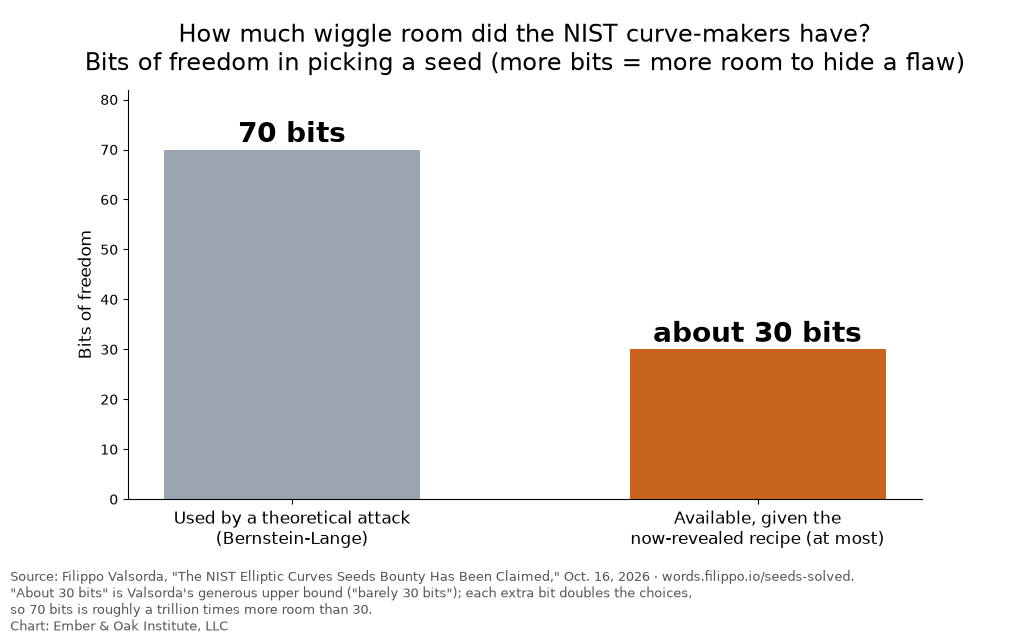
The recipe also answers an old worry. Researchers had described a theoretical way that someone with 70 bits of freedom in picking a seed could have aimed for a hidden weak curve. The revealed recipe left "barely 30 bits," and Valsorda wrote that the findings "completely rule out" that technique (Valsorda). A few questions remain open: why some usable candidates were skipped, how one seed for another curve was made, and how several curves' fixed "base points" were picked (Anthropic).
A referee for quantum designs
The second result, also published Oct. 16, shows what happens when the checking is built in from the start. Anthropic gave Claude Mythos 5 plain-language descriptions of eight quantum computer circuits from chemistry, optimization, physics and number theory. It added an automated evaluator that tested each design for correctness and scored it on how many qubits and gates it used. Claude proposed a design, got a score, and tried again, "with no human input between rounds," the company said.
"In seven of the eight tasks, the discovered circuits significantly reduce both Toffoli and qubit counts relative to the state of the art," the researchers reported in their paper, led by Andi Gu of Harvard and Anthropic's STEM Fellows Program, with co-authors from Anthropic, Harvard and QuEra Computing. In the eighth, Claude found a new way to do a costly piece of math called modular inversion. One version uses 12% more qubits than the smallest earlier design but 17 times fewer gates (Anthropic).
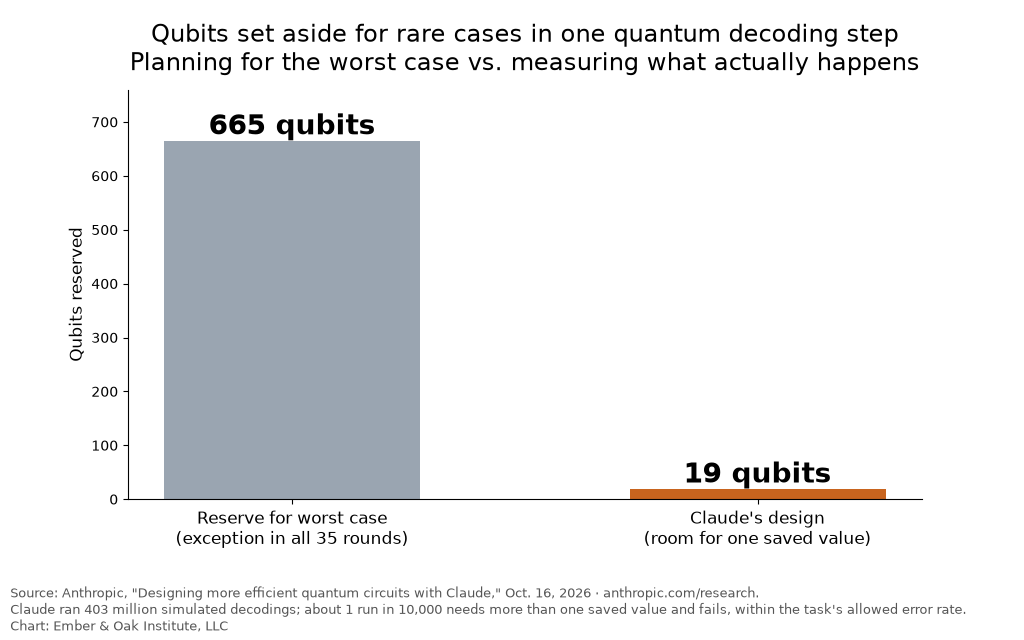
One detail stands out for anyone learning to build with AI. To decode errors in a promising quantum method, a circuit had to save rare "exception" values. Planning for the very worst case would have tied up 665 qubits. Instead, Claude wrote a fast simulator, ran 403 million sample decodings and found that almost every run needed room for one saved value at most. So it reserved 19 qubits and accepted that about one run in 10,000 would fail, within the error rate the task allowed. Together with other changes, the decoder needed 12 times fewer gates than Google's earlier design (Anthropic).
Speed is part of the story. A 150,000-fold drop in the estimated cost of one closely studied chemistry simulation "took many research groups eight years," Anthropic noted. Claude's elliptic-curve design came from a single 53-hour run (Anthropic).
So is caution, in both directions. Anthropic said Claude was "conservative by nature" and "repeatedly second-guessed apparent improvements," a habit that led it to write formal proofs in the Lean language but also made it favor familiar approaches until researchers nudged it to think bigger (Anthropic). The work is a preprint and has not yet been peer reviewed, and the Harvard and QuEra scientists are co-authors, not outside reviewers (arXiv).
Robots that can be stopped
The same idea, keeping a person able to watch and step in, showed up in robotics. Chinese robot maker Unitree on Oct. 16 introduced UniUni, which it calls an intelligent swarm control system. Unitree said it allows "rapid, intelligent choreography of swarm robot movements and formations, real-time device status monitoring, safety braking, and more" (Unitree on X). The software is listed for download on Unitree's UniUni portal.
Getting a group of robots to dance is the flashy part. Live status checks and a way to brake are what make it safe to try.
The flip side: copying is getting easy
AI's speed cuts both ways, and game makers are feeling it. Japanese studio Alliance Arts on Oct. 16 canceled the public demo of its upcoming game, planned for Oct. 19, and switched to small closed play sessions chosen by lottery. The studio said it worried that "works imitating or replicating this game's presentation and gameplay could be quickly produced using AI or other tools and released ahead of the game's launch." It also said it could not properly manage its planned limits on posting and streaming gameplay (Alliance Arts).
That is one small studio's call, not an industry trend yet. But it points the same way as the rest of the day's news. When building gets cheap, the hard-to-copy parts are good ideas, careful testing and judgment.
What it means at home
"Show your work" has long been the rule in math class. Friday's news suggests it is becoming the rule for machines, too. The breakthroughs people trusted came with a program anyone could rerun, a checker that graded every try, or a person ready to hit the brakes.
At Ember & Oak Institute, LLC, learners direct AI tools through a loop we call idea, build, test, improve, rather than hand-coding. This week is a reminder to give the test step real weight. Try it this weekend: have a learner pick a puzzle, such as a maze, a word scramble or sorting a list of moose sightings by date. Ask an AI tool to solve it, then ask it to build a separate checker that proves the answer is right. Then try to fool the checker. Keep a "How do we know?" note for each project. That is the same habit the quantum researchers and code breakers leaned on this week.
Sources
- Claude reveals ECDSA curve origins, Anthropic
- The NIST Elliptic Curves Seeds Bounty Has Been Claimed, Filippo Valsorda
- Designing more efficient quantum circuits with Claude, Anthropic
- Discovering state-of-the-art quantum circuits with large language models, arXiv:2610.22367
- Introducing UniUni Intelligent Swarm Control System, Unitree on X
- UniUni download portal, Unitree
- Change to the Demo Release Plan for Drunken Goddess Reflux, Alliance Arts