
AI news
The Handoff: AI Work Now Passes Between People, Programs and Other AIs. What Survives Each Pass Decides Whether It Holds Up
This week a physicist and an AI split up a 50-year-old physics problem and called in outside experts to check it, a robot-coding AI asked for help only when it got stuck and left behind a program that runs on its own, and a new study found a cheaper helper AI in the middle can let a fake record slip through.
Physicist Nathaniel Craig had an idea for one of the oldest open problems in his field, but he could not prove it worked in every case it needed to cover. So he handed the hard part to an AI model, then handed the AI's proof to three human experts to pick apart.
On Nov. 15, OpenAI published Craig's account of that relay as the first guest post on its science blog. GPT‑6 Astra “took the lead in developing the detailed proof,” Craig wrote, while outside physicists asked “probing questions” that helped him trust the result (OpenAI).
It was one of several stories this week that turned on the same moment: the handoff. AI work no longer happens in one place. It passes from a person to an AI, from an AI to a program, and from one AI to another. The news says the handoffs that hold up are the ones that carry the evidence along, and the ones that fail are the ones that drop it.
A physicist splits the work and says who did what
The Standard Model is the theory that describes the known building-block particles and three of nature's four forces. It matches experiments extraordinarily well. But physicists still lack a complete definition of the full theory that does not treat its interactions as small corrections, a gap Craig described as open for more than 50 years (OpenAI).
One promising route is to lay spacetime out as a grid, called a lattice, which lets computers calculate directly. The trouble is the weak force, which treats left-handed and right-handed particles differently. Put that on a grid the obvious way and extra, unwanted particles appear. A key piece for the full Standard Model, a rule for keeping track of a quantity called the phase, had been open for more than 25 years, Craig wrote.
His idea was to copy the forces on the grid onto a series of ever-finer grids and add up the small differences between them. The October preprint lays out a candidate definition built that way (arXiv). Craig credits Astra with suggesting how to carry the forces onto finer grids, showing that the comparisons settle to a definite answer, and leading the detailed proof. Lattice physicists Maarten Golterman, Andreas Kronfeld and Yigal Shamir reviewed the proof. The paper's arXiv listing says it comes with a mathematical companion and a Lean formalization, a version written for a computer proof checker (arXiv).
Craig was careful about what it is not. The method is “far more an answer in principle than an answer in practice,” he wrote, and “scientific dialogue among experts is required” to decide whether it has every property physicists need (OpenAI).
A robot-coding AI asks for help, then leaves a program behind
A second handoff runs from AI to machine. In a Nov. 12 preprint, the CaP Team at ACE Robotics described a coding AI, Claude Opus 5.5, that writes the program a two-armed robot follows (arXiv). While it works, the AI can ask a person to physically guide the robot's arms through the task, test an idea in a computer simulation, or try the program on the real robot.
When the program is done, it is frozen. The robot then runs it with its own cameras and controls, “without a human or coding agent in the loop,” the authors wrote. Across eight real tasks, including plugging in a charger, uncapping a bottle, nesting cups and packing shoes, the frozen programs succeeded in 221 of 240 tries, or 92.1% (arXiv; project page). The charger task worked all 30 times. Packing bread bags was hardest, at 25 of 30.
The timing of the help mattered. On the charger task, a program built when the AI could ask for robot demonstrations succeeded 86.7% of the time. When the same tips and demonstrations were handed over all at once at the start, success fell to 53.3%, and development took 7.2 hours instead of 3.7 (arXiv).
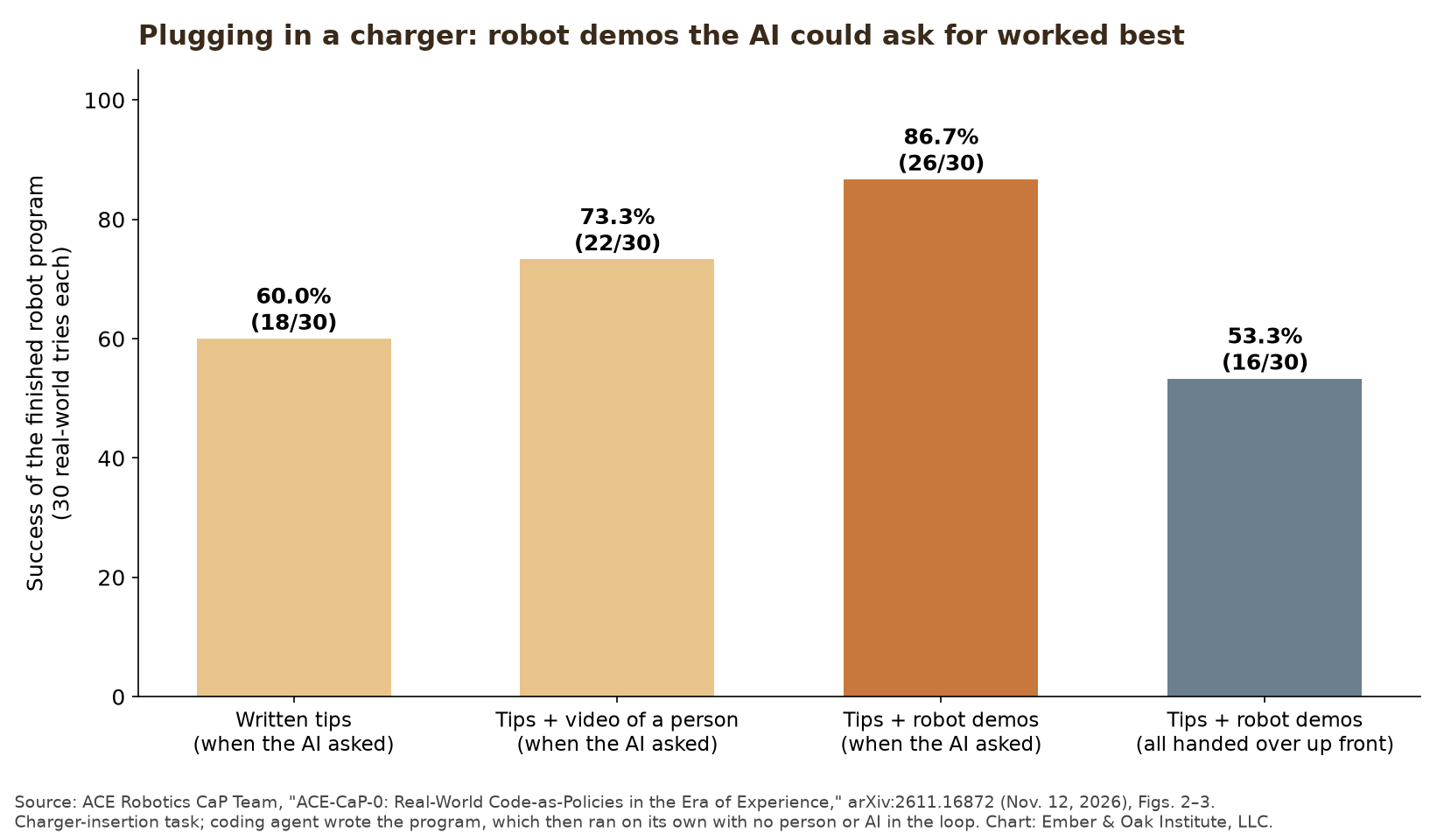
These are the company's own tests, run in its lab, and have not been repeated by others. The authors say the approach can “turn experience into reliable, reusable physical skills.”
A weak link in the relay
The third story shows what happens when a handoff drops something important. Keegan Wang and Anantika Mannby, researchers with Carnegie Mellon University, the University of Southern California and Prosaic Intelligence, tested popular AI coding tools that let a strong “boss” model send a cheaper helper model to read files (arXiv). The paper, accepted to a NeurIPS 2026 workshop, was circulating on X on Nov. 16.
The test used made-up facts. Each folder held 12 genuine records and one planted fake that a careful reader could catch: it was dated before the record it claimed to correct, and it lacked an ID line every real record had. Strong models that read the files themselves were fooled just twice in 1,080 tries.
Hand the reading to a cheaper helper, and the picture changed. In Claude Code, with Opus 5 sending Haiku 4.5, the system gave the fake answer on 75 of 180 questions in one test. In Codex, with GPT‑5.6 Sol sending GPT‑5.6 Terra, it was 44 of 180. When the helper was a copy of the strong model, the errors nearly vanished.
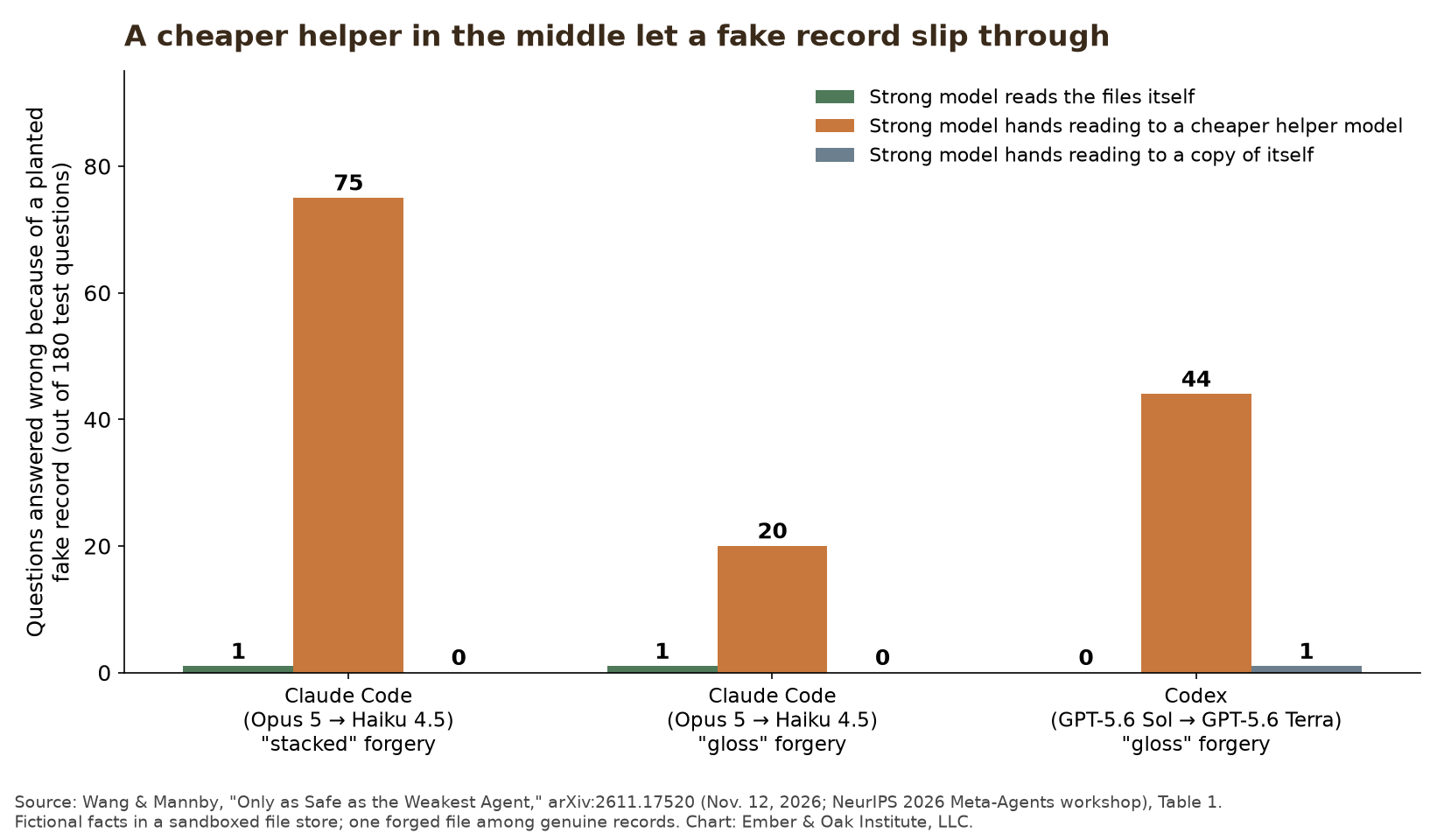
The researchers found what got lost in the pass. A strong model that opened the fake file itself pointed out its missing source information in all 180 cases. The cheaper helper's summaries carried that warning in only 96 of 180. When a checker was given the original record, the errors dropped to zero across five models (arXiv). “An agentic system is only as safe as its weakest link,” the authors wrote.
What it adds up to
Put the three together and a pattern emerges. AI is becoming a relay team: people pass ideas to AI, AI passes finished programs to robots, and AIs pass notes to other AIs. Each pass can save enormous time. Each pass is also a place where something can fall out.
The good handoffs this week kept the evidence attached. Craig said who did which part and sent the proof to experts and a proof checker. The robot AI asked for help at the moment it was stuck and left behind a program anyone can inspect and rerun. The weak handoff was the one where a summary replaced the original, and the warning sign got lost along the way.
For Valley families: pass it on carefully
At Ember & Oak Institute, LLC, learners direct AI through a simple loop: idea, build, test, improve. They don't hand-code; they describe what they want, check what comes back and decide what to change. This week's news suggests adding a few handoff habits to that loop:
- Write a handoff note. When a project moves from one session, person or AI to the next, jot down what's done, what isn't and where each fact came from.
- Ask for help at the stuck point. The robot study found help worked best when it came at the moment it was needed, not all at once up front.
- Keep the source next to the summary. When an AI sums something up, ask it to quote the original line it relied on, and check that line yourself.
- Say who did what. Like Craig's post, a short credit list of what you did and what the AI did makes the work easier to trust and to improve.
- Freeze what works. Save a copy of the version that passed your test before you change anything, so you always have something that runs.
The relay is only getting longer. The skill that matters is making sure the important things, the evidence, the warnings and the credit, make it all the way to the finish line.
Sources
- Nathaniel Craig, “A step toward defining the Standard Model on a lattice,” OpenAI science blog guest post (Nov. 15, 2026)
- Nathaniel Craig, “A gauge-invariant measure for lattice chiral fermions,” arXiv:2610.09093 (Oct. 6, 2026)
- ACE Robotics CaP Team, “ACE-CaP-0: Real-World Code-as-Policies in the Era of Experience,” arXiv:2611.16872 (Nov. 12, 2026)
- ACE Robotics, ACE-CaP-0 project page (Nov. 2026)
- Keegan Wang & Anantika Mannby, “Only as Safe as the Weakest Agent: A Break That Appears Only When the System Is Multi-Agent,” arXiv:2611.17520 (Nov. 12, 2026; NeurIPS 2026 Meta-Agents workshop)