
AI news
The Last Millimeter: Robots Are Learning to Feel Their Way Through Real Work
A new robot brain ran 27 robots it had never seen. A startup's force-sensing arm is wowing veteran roboticists. MIT researchers taught a robot to fit parts together with no camera at all, and a humanoid has walked for nine days straight. This week's robot news says the hard part is no longer knowing what to do. It is the touch, the fit and the stamina to do it for real.
The robot design is old enough to drive. Dream Labs says the PR2 research robot came out 18 years ago, and its new AI model, Dream-1, had never trained on one. In a demo the company released Monday, the model took over a simulated PR2's two arms anyway and pressed a big red button (Dream Labs).
The PR2, built by the robotics lab Willow Garage, was one of 27 robot bodies that San Francisco startup Dream Labs says its new model could steer in simulation without any data from those specific machines (Dream Labs). The company came out of stealth Monday with that model, Dream-1, and a public way for anyone with a compatible robot to try it (Dream Labs on X).
It was one of four robot stories that lit up X over the past two days, and they all point the same way. A day later, startup Eka Robotics announced a major funding round for a robot arm that, in one expert's words, has a "wow factor" (TechCrunch). MIT researchers showed a robot fitting pegs into holes with no camera at all (arXiv). And Figure AI's chief executive said the company's humanoid had walked a treadmill for nine days straight (Brett Adcock on X).
For years, robots have been good at knowing what to do and bad at doing it in a messy world. Eka co-founder Pulkit Agrawal, an MIT professor, calls the remaining gap "this last millimeter problem" (TechCrunch). This week, several teams showed real, if early, progress on it: robots that adapt to new bodies, feel their way through contact, and keep going long enough to prove they are reliable.
One brain, many bodies
Most robot software is trained for one machine. Move it to a different arm and it has to start over. Dream Labs is trying to break that pattern.
Dream-1 is what the company calls a "World Action Model." It predicts what the robot's camera will see next and the movements that will get there, at the same time. Because every robot shows up to a camera as shapes moving through a scene, the company says, video is "the one representation every robot type shares" (Dream Labs). Instead of commanding each joint, Dream-1 says where each gripper should go, and the robot's own software works out how to move its arm to get there.
The company's demo videos show the model folding shirts, hanging a mug on a hook and putting an egg into an empty spot in a carton, tasks it says it was never shown (Dream Labs). Beta testers ran it at sites in eight countries (Dream Labs on X).
The most useful number comes from someone else. Robocurve, a public benefit corporation that tests robot AI and publishes the results, ran Dream-1 before launch. It scored 59.3% on Robocurve's household-style robot test, the top score on Robocurve's leaderboard, ahead of big general-purpose AI models such as Google's Gemini 4 Argon at 48.2% (Robocurve).
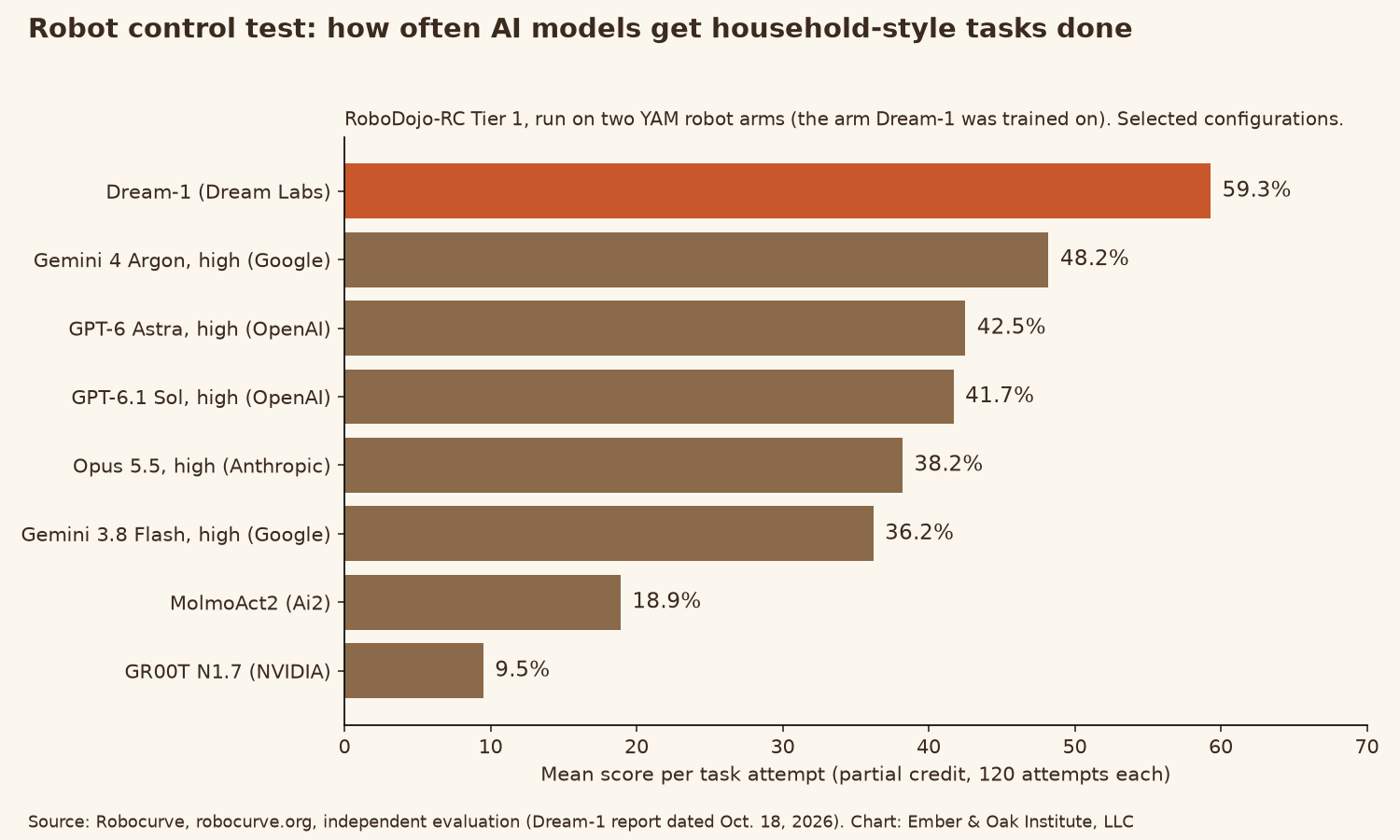
Dream-1 posted the top score in Robocurve's independent test, about 11 points ahead of the next-best configuration. The test runs on YAM arms, the robot Dream-1 was trained on, so it measures new tasks, not a new body. Source: Robocurve (Dream-1 report dated Oct. 18, 2026; scores are partial-credit means over 120 attempts). Chart: Ember & Oak Institute, LLC.
There is a catch worth teaching. Robocurve's test runs on two YAM robot arms (Robocurve), and YAM is "the robot Dream-1 was actually trained on," the company writes (Dream Labs). So that score shows how well Dream-1 handles new tasks, not new bodies. Dream Labs' own charts show performance varies from robot to robot, and the company calls Dream-1 a "research beta" that "will make mistakes" and has not been checked for safety-critical use (Dream Labs). "Robotics won't be solved on day one," it writes (Dream Labs).
A robot that touches first
Eka Robotics is betting on a different missing piece: the sense of touch.
Most new robot models link what a robot sees and what it is told to what it does. Eka built what it calls a "vision-force-action" model, which puts the forces a robot feels at the center, along with a softer gripper packed with force sensors (TechCrunch). "Vision tells you roughly where the object is, what the pose is, but the actual grabbing, the actual searching is happening through forces," Agrawal told TechCrunch (TechCrunch).
The company trains its robots mostly in a physics simulator rather than on videos of people, and says it can generate thousands of hours of robot practice in minutes (TechCrunch). Eka says its arm picks up about 1,500 objects an hour, compared with about 600 for a person, and succeeds more than 95% of the time (TechCrunch). The venture firm Andreessen Horowitz, which co-led the round, called the human hand possibly "the most economically important machine ever built" (a16z).
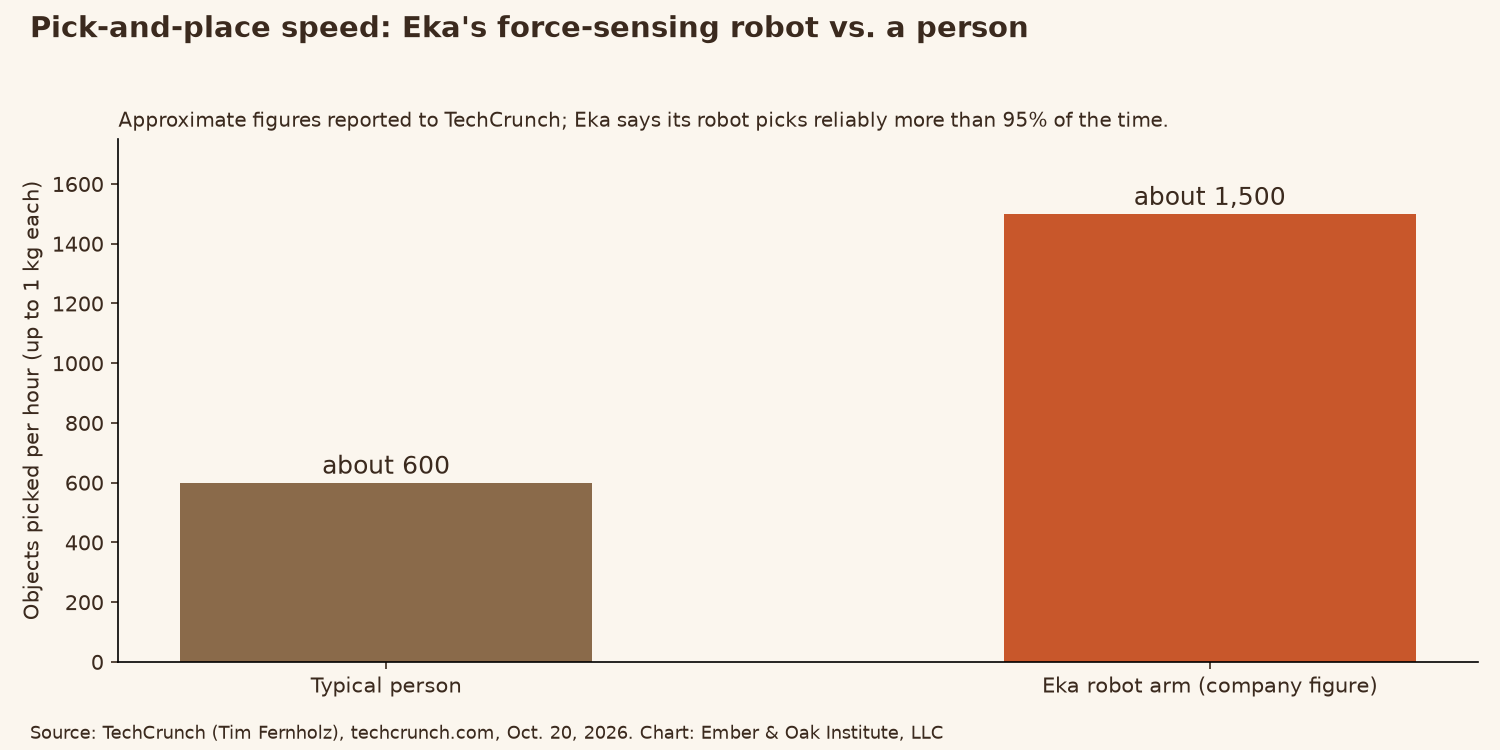
Eka says its arm picks about two and a half times as many objects per hour as a person and succeeds more than 95% of the time. These are company figures; outside testing on real factory lines has not been published. Source: TechCrunch, Oct. 20, 2026. Chart: Ember & Oak Institute, LLC.
Kris Hauser, a robotics professor at the University of Illinois Urbana-Champaign, said the arm "was able to adapt to a large number of different objects without retraining." He also noticed something more human: it "would try over and over again if it failed the first time" (TechCrunch).
Hauser was clear about what is left to prove. The big test, he said, comes "when they work with integrators on real assembly lines, and it needs to run without breaking for an entire year" (TechCrunch). Eka is running pilots with industrial customers but has not named them (TechCrunch).
Fitting parts together with its eyes closed
Agrawal's MIT lab pushed the touch idea even further in a paper posted Oct. 16. "Every robot already carries high-resolution contact sensors: its own joints," wrote the team, led by co-first authors Antonia Bronars and Younghyo Park (arXiv).
Their robot had no camera, no force sensor and no touch-sensitive skin. It only knew where its own joints had been over the last 0.6 seconds, how fast they were moving and what it had just tried. It was not told where the hole was or exactly how it was holding the part. Trained entirely in simulation, it learned to insert pegs, mesh gears and thread nuts (arXiv).
On a real robot, with no extra training, it fit eight differently shaped pegs, three of them shapes it had never practiced with, into holes with as little as half a millimeter of room on each side. It succeeded in 73% of 237 tries (arXiv). The team says that, to its knowledge, this is the first such demonstration. In simulated head-to-head tests, the "blind" robots handled unfamiliar part shapes and sizes far better than matched robots that used cameras, though they could be slower (arXiv). The researchers released their simulation tools as open source (project page).
Nine days on a treadmill
The last story is about plain endurance. On Monday, Figure AI CEO Brett Adcock posted that the company's Figure 03 humanoid "just crossed 9 straight days walking on this treadmill: 348 miles and 1.2 million steps." That is more than 13 marathons. The run "started as a side project to stress the robot for any failures," he wrote. "Let's see how long it can go" (Brett Adcock on X).
A treadmill is not a factory floor. But Hauser's year-without-breaking test is exactly the kind of question long, boring runs like this begin to answer.
What it adds up to
Put the four stories side by side and a pattern shows. The robots that impressed people this week did not just think harder. They adapted to a body they had never used, felt for the hole instead of only looking for it, tried again when they missed, and kept going for days.
That matches how people learn hands-on skills. Nobody learns to thread a nut by reading about it. You try, feel what went wrong, adjust and try again. It is the same idea, build, test, improve loop Ember & Oak Institute, LLC learners use when they direct an AI to build a project. And the honest caveats in this week's news are part of the lesson: a high score on the robot a model was trained on is not the same as working on a new robot, and a great lab demo is not a year on an assembly line.
For Valley families, the takeaway is practical. The robots coming into workshops, warehouses and maybe one day kitchens will be judged less on how smart they sound and more on whether they can handle the last millimeter, again and again.
Try it at home: Close your eyes and try to fit a key into a lock, or a peg into a hole in a block. Talk through what you feel: the edge catching, the slide, the moment it drops in. Then have your learner explain those steps to an AI helper and ask it to plan a simple robot routine that "searches" the same way. Test the plan by acting it out, and improve it where it fails.
Sources
- Zero-Shot to New Robots: Introducing Dream-1, Dream Labs (Oct. 2026)
- Dream Labs launch post on X (Oct. 19, 2026)
- Dream Labs on Robocurve's independent evaluation, X (Oct. 19, 2026)
- Robocurve: Real-world evaluations of physical AI (RoboDojo-RC Tier 1 results)
- Preliminary Indicators for Robotics Progress, Robocurve (Oct. 15, 2026)
- Tim Fernholz, TechCrunch, on Eka Robotics' Series A and vision-force-action model (Oct. 20, 2026)
- Investing in Eka Robotics, Yoko Li and Raghu Raghuram, Andreessen Horowitz (Oct. 20, 2026)
- Blind Precise Assembly: Proprioceptive Sim-to-Real Peg-in-Hole for Diverse Parts, Bronars, Park, Kedia, Agrawal, arXiv:2610.23849 (Oct. 16, 2026)
- Blind Precise Assembly project page (videos and simulations)
- Brett Adcock on Figure 03's nine-day treadmill walk, X (Oct. 19, 2026)